Cartagena Walled City: The Complete Guide to Cartagena’s Old Town11 min read
The Cartagena walled city is the reason most travelers fall in love with Colombia’s Caribbean coast. Behind stone ramparts built over two centuries, you will find colonial churches, flower-draped balconies, shaded plazas and streets painted in yellow, ochre and blue. Known locally as the Ciudad Amurallada or simply el Centro, Cartagena’s old town is part of a UNESCO World Heritage Site and one of the best-preserved colonial cities in the Americas.
This guide covers the history of the walls, the sights you should not miss, the best time of day to explore, and practical tips on heat, food and safety. If you prefer to see it all with an expert, our private Cartagena city tour takes you through the highlights at your own pace.
A UNESCO World Heritage Site Since 1984
In 1984, UNESCO inscribed the “Port, Fortresses and Group of Monuments, Cartagena” on its World Heritage List. UNESCO describes Cartagena’s defenses as the most extensive fortifications in South America. The site includes the walled city’s three historic districts: San Pedro, with the cathedral and the grand Andalusian-style mansions of the wealthy; San Diego, where merchants and the middle class lived; and Getsemaní, the working-class quarter of artisans and laborers. It also includes the Castillo San Felipe de Barajas and the harbor fortresses that guarded the bay.
Why Cartagena Built Its Walls
Pedro de Heredia founded Cartagena de Indias on June 1, 1533. The city quickly became one of Spain’s most important ports in the Caribbean. Silver and gold from the colonies passed through it on their way to Spain, and that wealth made it a target.
Pirates and privateers attacked the city repeatedly in the 16th century. The most famous raid came in 1586, when Sir Francis Drake arrived with 23 ships and more than 2,000 men. Drake’s forces burned some 200 houses and part of the cathedral and left only after the city paid a large ransom. The attack convinced the Spanish Crown that Cartagena needed serious defenses. Italian military engineer Bautista Antonelli was commissioned to design a fortification system, and construction continued, with interruptions and redesigns, for roughly two centuries.
The defenses were tested again by the French Baron de Pointis in 1697, who sacked the city, and in 1741 by a massive British force under Admiral Edward Vernon. That time, Spanish commander Blas de Lezo and the city’s defenders held on, and the siege failed. Today, the walls and bastions stretch for roughly 11 kilometers (about 7 miles) around the historic center and Getsemaní, making them one of the most complete colonial wall circuits in the Americas.
Top Things to Do in Cartagena Walled City
Clock Tower (Torre del Reloj)
The yellow Clock Tower is the main entrance to the walled city and the symbol of Cartagena. It stands where the old main gate, the Boca del Puente, once connected the walled center with Getsemaní by a bridge. The gate structure dates to the early 18th century, and the clock tower on top was added later. Walk through its arches and you step straight into the old town.
Plaza de los Coches
Just inside the Clock Tower is the Plaza de los Coches. During the colonial period, this triangular square was associated with the trade in enslaved Africans, a painful history worth remembering as you admire the arcades. Today the Portal de los Dulces, a covered arcade along one side, is famous for its stalls of traditional Cartagena sweets: cocadas, alegrías, tamarind balls and more. A statue of Pedro de Heredia stands in the center.
Plaza Santo Domingo and Botero’s Gertrudis
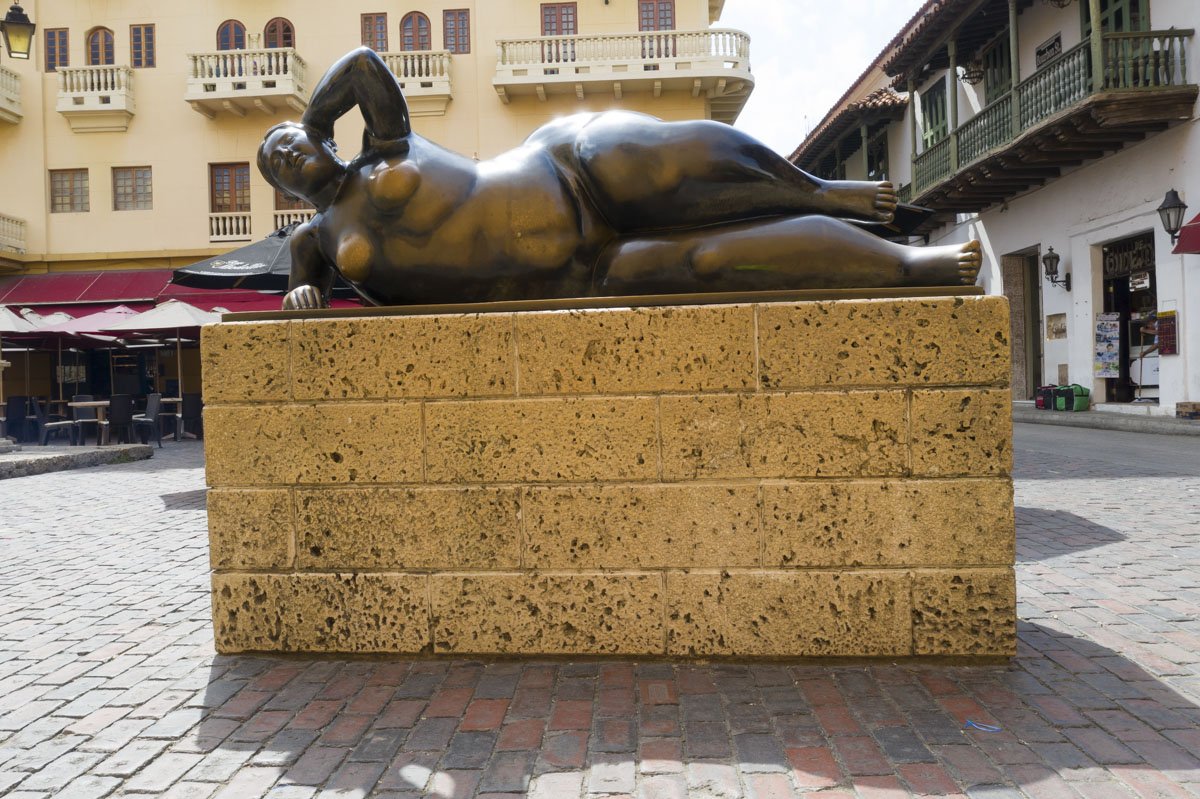
Plaza Santo Domingo is one of the liveliest squares in the old town, lined with restaurant terraces in front of the Church of Santo Domingo, one of the oldest churches in the city. In the square rests a reclining bronze woman by Colombian master Fernando Botero, officially titled Figura Reclinada but known by everyone as “La Gorda Gertrudis.” It was a gift from the artist to the city, and locals say touching it brings good luck.
Cathedral of Cartagena
The Cathedral of Santa Catalina de Alejandría faces Plaza de Bolívar. Construction began in the 16th century, and it was damaged during Drake’s attack before work resumed. Its massive walls, simple interior and bell tower, which received its current dome in the early 20th century, make it one of the landmarks of the skyline.
Palace of the Inquisition
Also on Plaza de Bolívar, the Palace of the Inquisition is one of the finest examples of colonial civil architecture in Cartagena, with a baroque stone portal completed in the 18th century. Cartagena was one of the seats of the Spanish Inquisition in the Americas. Today the building is a history museum where you can learn about the city’s colonial past and the tribunal’s grim methods.
San Pedro Claver Church and Cloister
This church and convent is dedicated to Saint Peter Claver, a Spanish Jesuit who spent decades ministering to enslaved Africans arriving at the port in the 17th century. He called himself “the slave of the slaves forever.” His remains rest beneath the main altar. The cloister, with its tropical garden, is one of the most peaceful spots in the old town.
Las Bóvedas
Completed in the 1790s to plans by engineer Antonio de Arévalo, Las Bóvedas is a long building of 23 vaults set into the walls in the San Diego district. It was designed as bomb-proof barracks for royal troops and later used as a prison. Today the vaults house handicraft shops, making it a good place to buy hammocks, mochilas and souvenirs.
Walking on the Walls
One of the best things to do in Cartagena is simply to walk on top of the walls. The ramparts are wide, and from them you can see the Caribbean on one side and the rooftops and church domes on the other. The stretch near Las Bóvedas and the area around the Café del Mar on the Baluarte de Santo Domingo are especially popular at sunset.
Getsemaní
Just outside the main walls, Getsemaní was once the neighborhood of artisans and laborers. Today it is the city’s most creative quarter, known for its street art, umbrella-covered streets, small plazas and nightlife. Plaza de la Trinidad comes alive in the evenings with locals, street food and music. It is part of the UNESCO site and an essential stop on any Cartagena city tour.
Want context for every plaza and church? Our Cartagena city tour combines the walled city, Getsemaní and the fortress with a local guide who knows the stories behind each corner.
Beyond the Walls: San Felipe Castle and La Popa
Castillo San Felipe de Barajas
Rising on San Lázaro hill just east of the old town, the Castillo San Felipe de Barajas is the largest fortress the Spanish built in their American colonies. Its first fort was completed in 1657, and it was greatly expanded in the 18th century by Antonio de Arévalo. Its tunnels, ramps and batteries played a key role in repelling Admiral Vernon’s attack in 1741. Climbing to the top rewards you with sweeping views of the city.
Convent of La Popa
The Convent of Nuestra Señora de la Candelaria sits atop La Popa hill, the highest point in Cartagena. Founded in the 17th century, it offers the best panoramic view of the city, the bay and the walled center. Because of its location, it is best visited by car or as part of a guided tour.
Best Time of Day to Visit the Old Town
Cartagena is hot and humid all year, with temperatures usually in the high 80s °F (around 30–32 °C). The best times to explore Cartagena old town on foot are early morning, from about 7 to 10 a.m., when the light is soft and the streets are quiet, and late afternoon, from about 4 p.m. onward, when the sea breeze picks up and the walls glow at sunset. Midday is ideal for museums, air-conditioned cafés, a long lunch or a siesta.
The evening is magical too. Plazas fill with music, horse carriages circulate and the colonial facades are lit up. Many travelers find the city at night their favorite version of it.
Practical Tips for Exploring the Walled City
- Beat the heat: wear light, breathable clothing, a hat and sunscreen, and carry water. Stop often in shaded plazas.
- Wear comfortable shoes: streets are uneven stone and the walls have ramps and steps.
- Carry some cash: small vendors, fruit sellers and street musicians usually prefer cash.
- Photos with palenqueras: the colorfully dressed fruit sellers are a symbol of the city. Ask first and expect to buy fruit or tip. Learn their story in our guide to San Basilio de Palenque.
- Agree on prices first: for horse carriages, street vendors and taxis without meters.
Where and What to Eat
The walled city has a huge dining scene, from fine dining to simple local spots. Do not leave without trying:
- Arepa de huevo: a fried corn arepa with an egg inside, a Caribbean coast classic.
- Ceviche and seafood: Cartagena-style ceviche is often served with a slightly sweet sauce.
- Fried fish with coconut rice and patacones: the classic coastal plate.
- Fresh fruit juices and limonada de coco: the perfect remedy for the heat.
- Traditional sweets from the Portal de los Dulces.
To taste the real everyday food of Cartagena, join our Bazurto Market food tour, an immersive visit to the city’s biggest and most chaotic market.
Is the Cartagena Walled City Safe?
The walled city is one of the most visited and well-policed areas in Colombia, and it is generally considered safe for tourists, day and night. As in any popular destination, use common sense: keep valuables out of sight, watch your phone in crowds, use registered taxis or ride-hailing apps at night, and politely decline persistent street vendors. Getsemaní is lively and popular in the evenings, but stick to well-lit, busy streets.
Combine Your Visit With Other Experiences
Most travelers spend one or two days exploring the old town and then head out to discover the surroundings. Popular options include a day on the islands, which you can plan with our guide to the Rosario Islands, or a cultural trip to Palenque. See all our day tours from Cartagena for ideas.
Frequently Asked Questions About the Cartagena Walled City
How much time do I need to see the Cartagena walled city?
You can see the main highlights in a half day, but one to two days lets you explore at a relaxed pace, including Getsemaní, the walls at sunset and San Felipe Castle.
Is the walled city of Cartagena a UNESCO World Heritage Site?
Yes. It is part of the “Port, Fortresses and Group of Monuments, Cartagena,” inscribed on UNESCO’s World Heritage List in 1984.
How long are the walls of Cartagena?
The walls and bastions are generally described as stretching about 11 kilometers (around 7 miles) around the historic center.
Can you walk on the walls of Cartagena?
Yes. Large sections of the walls are open to the public and free to walk. They are especially popular at sunset.
Is San Felipe Castle inside the walled city?
No. Castillo San Felipe de Barajas sits on San Lázaro hill, a short drive or a walk of about 20 to 30 minutes from the Clock Tower, outside the walls.
Is a private Cartagena city tour worth it?
A private tour adds history and context you would miss on your own, handles transport to San Felipe and La Popa, and lets you avoid the hottest hours. It is ideal for first-time visitors and cruise passengers with limited time.
Discover Cartagena’s Old Town With a Local
The Cartagena walled city rewards slow exploration: a plaza at dawn, a church cloister at noon, a rampart at sunset. Understanding its history, from Drake’s raid to the African heritage that shaped its streets, makes every corner more meaningful. Book our private Cartagena city tour and see the old town through the eyes of a local guide.
Further reading: Port, Fortresses and Group of Monuments, Cartagena (UNESCO), Cartagena, Colombia (Wikipedia), Castillo San Felipe de Barajas (Wikipedia), Las Bóvedas (Wikipedia).