San Basilio de Palenque: History, Culture and How to Visit Colombia’s First Free Town19 min read
San Basilio de Palenque is a small village of roughly 3,500 people in the foothills of the Montes de María, about 50 kilometers (31 miles) southeast of Cartagena. It looks modest at first glance: dirt streets, low houses, children playing, a statue in the main square. Yet this is one of the most important places in the history of the Americas. Founded by people who escaped slavery in the early 1600s, Palenque is widely recognized as the first free town in the Americas, and its culture is recognized by UNESCO as a Masterpiece of the Oral and Intangible Heritage of Humanity.
If you are planning a trip to Cartagena and want to understand Afro-Colombian culture beyond the postcard image, this guide covers everything: the history of Benkos Biohó and the cimarrones, the Palenquero language, music, boxing, food, and the wider Afro-Colombian world from the Pacific coast to San Andrés. When you are ready to go, our private San Basilio de Palenque tour from Cartagena pairs you with a local guide from the community.
Where Is Palenque, Colombia?
San Basilio de Palenque belongs to the municipality of Mahates in the department of Bolívar, the same department as Cartagena. The drive from Cartagena usually takes around one hour to one hour and a half, depending on traffic leaving the city. The last stretch leaves the main highway and runs through cattle country and low hills.
The village sits close to the Montes de María, a range of forested hills that, four centuries ago, offered shelter to people fleeing the slave port of Cartagena. That geography is the reason Palenque exists at all. Dense vegetation, swamps and difficult terrain made it hard for Spanish forces to reach and destroy the settlements of escaped Africans.
The History of San Basilio de Palenque
Cartagena and the Slave Trade
During the colonial period, Cartagena de Indias was one of the main ports through which enslaved Africans entered Spanish America. Thousands of men, women and children were brought from West and Central Africa, sold in the city and forced to work in households, haciendas, mines and the construction of the very fortifications that tourists admire today.
Resistance began almost immediately. Enslaved people escaped into the swamps and hills surrounding the city and formed fortified communities known as palenques. The escapees were called cimarrones (maroons). Many palenques existed in the region during the 17th century. Most were destroyed or dispersed. San Basilio is the one that survived.
Benkos Biohó, the Maroon King
The central figure in Palenque’s founding story is Benkos Biohó. According to historical accounts, he was born in West Africa, in the region of present-day Guinea-Bissau (his name is often linked to the Bijagós islands), captured, and brought to Cartagena as an enslaved man. Around 1599, he led a group of roughly 30 escaped slaves into the forests and swamps south of the city.
Biohó proclaimed himself king and organized a resistance network that raided haciendas, freed other enslaved people and fought off Spanish expeditions. He became so troublesome to the colonial authorities that they eventually negotiated terms with him. The peace did not last. The Spanish later captured Biohó, accused him of conspiracy and hanged him in 1621.
Today, a bronze statue of Benkos Biohó stands in Palenque’s main square, his arms raised and chains broken. For many Afro-Colombians, he is a national hero and a symbol of freedom that long predates Colombia’s independence from Spain.
How Palenque Became a Free Town
You will often read that Palenque was declared free by a royal decree in 1713. The real history is a little more nuanced, and it is worth getting right. Tradition places the founding of the settlement around 1603, though the exact year is unknown. The community resisted Spanish military campaigns for decades. A royal decree issued in 1691 offered freedom guarantees to the palenqueros, and in 1713, after a long period of fighting, an agreement brokered by Bishop Antonio María Casiani recognized the community and its land. The village, originally known as Palenque de San Miguel Arcángel, was renamed San Basilio Magno at that time.
Whatever date you choose, the significance is the same. Palenque secured its freedom more than a century before Colombia abolished slavery and long before most of the Americas did. That is why it is so often described as the first free town in the Americas.
UNESCO Recognition: A Masterpiece of Intangible Heritage
In 2005, UNESCO proclaimed the Cultural Space of Palenque de San Basilio a Masterpiece of the Oral and Intangible Heritage of Humanity. The element was later incorporated into UNESCO’s Representative List of the Intangible Cultural Heritage of Humanity. The recognition does not refer to buildings or monuments. It refers to living traditions: the language, social organization, funeral rites, medicine, music and oral history that the community has preserved for four centuries.
UNESCO also noted the threats facing these traditions, including the decline of the Palenquero language among younger generations, migration to cities and the pressure of discrimination. That context matters for visitors. When you visit, you are not entering a museum. You are entering a community that is working, every day, to keep its heritage alive.
Palenquero: The Only Spanish-Based Creole in South America
Palenquero (in the language itself, lengua ri Palenge) is considered the only Spanish-based creole language in South America. It combines Spanish vocabulary with grammar and words of African origin, especially from Kikongo, a Bantu language of Central Africa. Linguists have identified hundreds of words of African origin in Palenquero, and its plural marker ma comes directly from Kikongo.
For a Spanish speaker, Palenquero sounds familiar but is not easy to follow. Verbs are not conjugated the Spanish way, and word order and particles work differently. The language was long stigmatized, and in the 20th century many families stopped teaching it to their children. Since the 1990s, community leaders and teachers have reintroduced it in local schools, and young musicians now rap and sing in Palenquero with real pride. Colombia’s Constitution recognizes the languages of ethnic groups as official in their territories.
On a visit, your guide will likely teach you a few phrases. A simple greeting in Palenquero earns warm smiles.
Social Organization: The Kuagros
One of the most distinctive features of life in Palenque is the kuagro. Kuagros are groups formed by age, usually starting in childhood, that bring together people of the same generation from the same part of the village. Members of a kuagro support each other throughout their lives: they help with work, share celebrations, defend one another and accompany each other in moments of loss.
Kuagros have their own internal rules and a strong sense of loyalty. Anthropologists have linked this system to forms of age-based organization in Central and West Africa. In practical terms, the kuagro is a key reason the community has stayed so cohesive over centuries, even as many residents moved to Cartagena, Barranquilla or Venezuela in search of work.
Lumbalú: Palenque’s Funeral Rite
When someone dies in Palenque, the community performs the lumbalú, a funeral ritual of songs, drumming and dance. Women sing chants, some of them in Palenquero and with words of African origin, while drummers play the pechiche and other traditional drums. The ritual accompanies the deceased and the family through the mourning period, which traditionally includes several nights of wake.
Lumbalú reflects a worldview in which death is a passage, not an end. It is one of the traditions UNESCO highlighted in its recognition. It is also a private, sacred ceremony. Visitors should never expect to see it as a performance; a good guide will explain its meaning, and sometimes elders or cultural groups share songs that come from this tradition.
Traditional Medicine
Palenque has a long tradition of herbal and traditional medicine. Healers and knowledgeable elders use plants from the surrounding hills and patios to prepare remedies for common ailments, women’s health, children’s illnesses and snakebites. This knowledge was passed down orally from generation to generation and is part of the cultural space recognized by UNESCO.
Many tours include a visit with a local traditional medicine practitioner who shows the plants, explains how they are prepared and talks about the spiritual side of healing. It is one of the most fascinating parts of a day in Palenque, and it is a direct line to knowledge that the cimarrones carried with them into the forest.
Ready to experience these traditions with someone who grew up with them? Book our Palenque tour from Cartagena and your guide will introduce you to musicians, healers and cooks in the village.
The Music of Palenque
Son Palenquero and the Drums
Drums are the heartbeat of Palenque. Traditional rhythms such as the bullerengue, son palenquero and the music of lumbalú are played on hand drums like the tambor alegre, the llamador and the pechiche. Son palenquero blends Cuban son, which arrived on the Caribbean coast in the 20th century, with local African-rooted percussion. Groups like Sexteto Tabalá have carried this sound to international stages.
Champeta Roots
Champeta, the high-energy dance music that fills Cartagena’s streets and picós (giant decorated sound systems), has deep roots in Palenque and in the Afro-descendant neighborhoods of Cartagena. In the 1970s and 1980s, records from Africa, including Congolese soukous and West African highlife, arrived through the port and became hugely popular in the Caribbean coast. Local musicians, many of them palenqueros, began to create their own versions, sometimes singing in Palenquero. That fusion grew into champeta criolla.
For decades, champeta was dismissed by the elite as music of the poor. Today it is a source of pride in Cartagena and an essential part of Afro-Colombian culture.
Kombilesa Mi: Rap in Palenquero
A new generation is reinventing the tradition. Kombilesa Mi (meaning “my friends” in Palenquero) is a group from Palenque that mixes hip-hop with traditional drums and sings in Palenquero. Their “rap folclórico palenquero” addresses identity, discrimination and pride, and the group has toured internationally, including in the United States. Kombilesa Mi is a great example of how young palenqueros are using contemporary music to keep their language alive.
Kid Pambelé and Palenque’s Boxing Legacy
Palenque has a surprising connection to world sports. Antonio Cervantes, better known as Kid Pambelé, was born in San Basilio de Palenque. He became Colombia’s first great world boxing champion, holding the WBA light welterweight title from 1972 to 1976 and again from 1977 to 1980, with more than a dozen successful title defenses across his two reigns. He remains one of the most celebrated athletes in Colombian history.
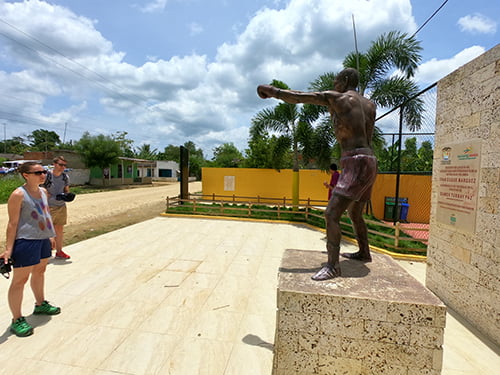
Pambelé’s success inspired a boxing tradition in the village. You will see a statue honoring him in Palenque, and locals are proud to talk about the champions the village has produced.
Palenqueras: The Fruit Sellers of Cartagena
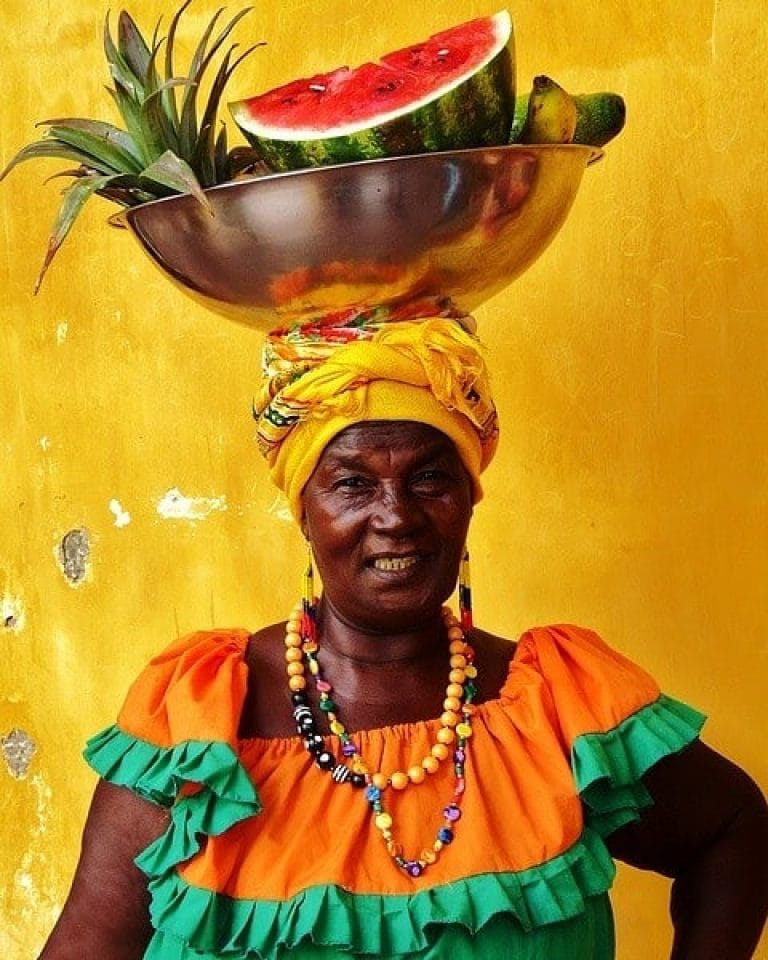
If you have seen a photo of Cartagena, you have probably seen a palenquera. These women, dressed in bright dresses in the colors of the Colombian flag and other vivid tones, balance large basins (palanganas) of tropical fruit on their heads as they walk the streets of the old town. They have become one of the most recognizable images of Cartagena and appear in tourism campaigns, paintings and souvenirs.
The image has a real history behind it. For generations, women from San Basilio de Palenque traveled to Cartagena to sell fruit, cocadas and other sweets, supporting their families with this trade. Their presence in the city is a living link between Palenque and Cartagena. You will meet them in the plazas of the walled city, and our private Cartagena city tour includes the story behind them. You can also read more in our guide to the Cartagena walled city.
A note on etiquette: palenqueras often pose for photos, and it is customary to buy fruit or offer a tip if you photograph them. Ask first, agree on the amount, and remember that they are working.
Palenque Cuisine: Cocadas, Alegrías and More
Palenque is famous across the Caribbean coast for its sweets. The best known are:
- Cocadas: coconut sweets cooked with sugar or panela, sometimes flavored with tropical fruit like guava, pineapple or tamarind.
- Alegrías: small balls made with toasted millet (millo), coconut and panela, a sweet that palenqueras have sold for generations.
- Enyucados and caballitos: other traditional sweets made with cassava, coconut or papaya that you may find depending on the season.
Everyday meals often include fried fish, rice with coconut, plantains, cassava and stews. Many visitors enjoy lunch prepared by a local family, which is one of the most rewarding parts of the day because it directly supports the community.
Afro-Colombian Culture Beyond Palenque
Palenque is one chapter in a much larger story. Colombia has one of the largest populations of African descent in Latin America, and Afro-Colombian culture shapes the country’s music, food, language and identity.
How Many Afro-Colombians Are There?
According to Colombia’s national statistics agency, DANE, the 2018 National Population and Housing Census counted about 2.98 million people who identify as Black, Afro-Colombian, Raizal or Palenquero, around 6.7% of the population. That figure is widely disputed. The 2005 census had recorded about 4.3 million (around 10.6%), and DANE itself acknowledged problems with how the ethnic self-identification question was captured in 2018. Many Afro-Colombian organizations believe the real number is considerably higher. Of the 2018 total, a little over 6,600 people identified as Palenquero and around 25,500 as Raizal.
The Pacific Coast: Chocó, Buenaventura and Tumaco
The largest concentration of Afro-Colombians lives along the Pacific coast. In Chocó department, the vast majority of residents are of African descent; its capital, Quibdó, is overwhelmingly Afro-Colombian. The port cities of Buenaventura (Colombia’s main Pacific port) and Tumaco in Nariño also have Afro-Colombian majorities of more than 80%.
This region is the birthplace of marimba music, the currulao and the powerful cantos of women singers. The music and traditional chants of the South Pacific region are also recognized by UNESCO as intangible cultural heritage. The Pacific is also one of the most biodiverse regions on Earth, and one of the most historically neglected by the state.
San Andrés: The Raizal People
In the Caribbean archipelago of San Andrés, Providencia and Santa Catalina, the Raizal people form a distinct Afro-Caribbean community. Their history is linked to British and Caribbean settlement, they are traditionally Protestant, and they speak San Andrés-Providencia Creole, an English-based creole. Their culture feels closer to Jamaica than to mainland Colombia.
Law 70 of 1993
Colombia’s 1991 Constitution recognized the country as multiethnic and multicultural. Two years later, Law 70 of 1993 (the Law of Black Communities) recognized the right of Black communities to collective ownership of the lands they had traditionally occupied, especially along the rivers of the Pacific basin. It also established protections for their cultural identity and ethnic education. Thanks to this law, community councils have received collective titles to millions of hectares. The law was a milestone, although implementation has faced many challenges, including armed conflict and displacement.
Afro-Colombian Day: May 21
Every May 21, Colombia celebrates the Día de la Afrocolombianidad (Afro-Colombian Day). The date commemorates the law signed on May 21, 1851, that abolished slavery in Colombia, which took effect on January 1, 1852. Schools, cities and cultural organizations mark the day with music, dance, debates and festivals.
Cultural Festivals Worth Planning Around
Festival de Tambores y Expresiones Culturales de Palenque
Every October, San Basilio de Palenque hosts the Festival de Tambores y Expresiones Culturales (Festival of Drums and Cultural Expressions). The 2024 edition, held October 11 to 14, was the 39th. The festival brings together drum and dance groups from across Colombia and beyond, along with workshops on traditional medicine, the Palenquero language, braided hairstyles and percussion. If your travel dates are flexible, this is the most vibrant time to visit, though it is also the busiest.
Festival Petronio Álvarez in Cali
Held every year in August in Cali, the Petronio Álvarez Pacific Music Festival is the largest celebration of Afro-Colombian culture in the country. It began in 1997 and is named after a celebrated composer from Buenaventura. The festival features marimba ensembles, chirimía bands, violin groups from the Cauca region, Pacific cuisine and the famous viche, a traditional sugarcane spirit. It draws hundreds of thousands of attendees.
How to Visit San Basilio de Palenque Respectfully
Palenque welcomes visitors, and responsible tourism brings income and visibility to the community. A few simple practices make a big difference:
- Ask before photographing people, especially elders and children. Many residents are happy to be photographed, but asking first is basic respect.
- Buy local: sweets, handicrafts, music and meals from Palenque families. Spending money directly in the village is the best way to support it.
- Listen more than you talk. Palenque’s history is told orally, and the best moments of a visit are often conversations.
- Dress comfortably and modestly. It is hot, but this is a residential community, not a beach resort.
- Do not treat traditions as shows. Music and dance presentations are offered with pride, but rituals like lumbalú are sacred.
- Bring cash in small bills. There are few or no card payment options in the village.
Why Visit Palenque With a Local Guide
You can technically reach Palenque on your own, but public transport is complicated, signage is minimal and, more importantly, you will miss most of what makes the village special. Palenque’s heritage is intangible. It lives in people, not in signs or museums. Without a connection to the community, you will see houses and a statue. With a local guide, you will meet the healer who explains the plants, the musicians who play the drums, the women who cook the cocadas and the elders who tell the story of Benkos Biohó.
A good guide also makes sure your visit benefits the community fairly, handles transportation from Cartagena safely and comfortably, and helps you navigate etiquette so that both you and your hosts enjoy the experience. Private tours let you set the pace, ask as many questions as you want and adapt the day to your interests, whether that is music, history, food or language.
If you want to combine Palenque with other experiences outside the city, browse our day tours from Cartagena.
Frequently Asked Questions About San Basilio de Palenque
How far is San Basilio de Palenque from Cartagena?
Palenque is about 50 kilometers (31 miles) southeast of Cartagena. The drive typically takes between one hour and one and a half hours, depending on traffic.
Why is Palenque called the first free town in the Americas?
It was founded by people who escaped slavery in the early 1600s, led by Benkos Biohó, and it obtained recognition of its freedom from the Spanish authorities: a royal decree in 1691 offered freedom guarantees and a 1713 agreement recognized the community. That was more than a century before slavery was abolished in Colombia.
When did UNESCO recognize San Basilio de Palenque?
UNESCO proclaimed the Cultural Space of Palenque de San Basilio a Masterpiece of the Oral and Intangible Heritage of Humanity in 2005. It is now part of the Representative List of the Intangible Cultural Heritage of Humanity.
What language do people speak in Palenque?
Residents speak Spanish and Palenquero, a Spanish-based creole with strong influence from Kikongo and other African languages. It is considered the only Spanish-based creole language in South America.
Is it safe to visit Palenque?
Palenque is a peaceful, welcoming community, and thousands of visitors go each year. As with any rural trip, it is best to travel with a reputable local operator who handles transport and introductions.
How much time do I need for a Palenque tour from Cartagena?
Plan for a half day to a full day. Most private tours last around six to eight hours, including the drive, a guided walk, music, a traditional medicine visit and lunch with a local family.
What should I bring to Palenque?
Bring light clothing, sunscreen, a hat, insect repellent, water and cash in small bills to buy sweets, crafts or tip musicians.
Plan Your Visit to San Basilio de Palenque
San Basilio de Palenque is not a typical tourist attraction. It is a living community whose ancestors fought for their freedom four centuries ago and won. Visiting gives you a deeper understanding of Cartagena, of Colombia and of the African diaspora in the Americas. It is one of the most meaningful day trips you can take from the city.
Let a local guide open the doors for you. Book our private San Basilio de Palenque tour and spend a day with the community that gave the Americas its first free town.
Further reading: San Basilio de Palenque (Wikipedia), El espacio cultural de Palenque de San Basilio (UNESCO), Palenquero language (Wikipedia), Benkos Biohó (Wikipedia), Afro-Colombians (Wikipedia).